
Aparate de zbor individuale George de Bothezat
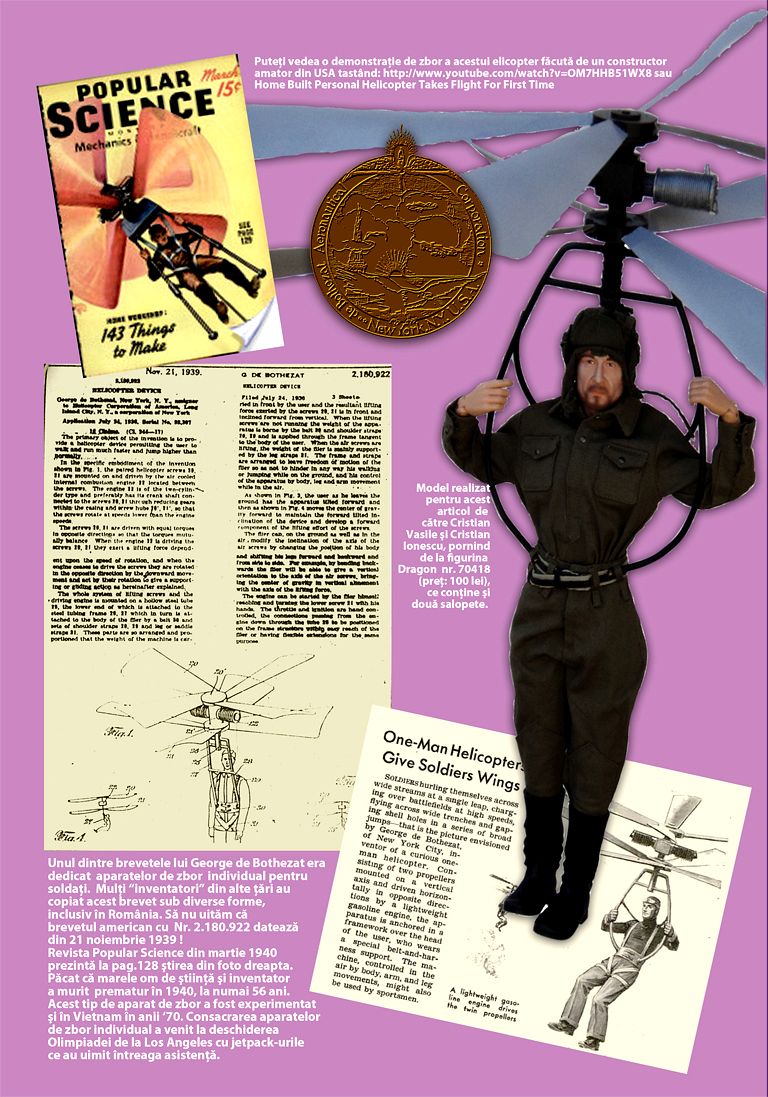
Puteţi vedea o demonstraţie de zbor a acestui elicopter făcută de un constructor amator din USA tastând: http://www.youtube.com/watch?v=OM7HHB51WX8 sau Home Built Personal Helicopter Takes Flight For First Time
Nov. 21, 1939. G DE BOTHEZAT HELICOPTER DEVICE George de Bothezat Application July 24, 1936 2,180,922
The primary object of the invention is to provide a helicopter device permitting the user to walk and run much faster and jump higher than normally.
In the specific embodiment of the invention shown in Fig. 1, the paired helicopter screws 20, 21 are mounted on and driven by the air cooled internal combustion engine located between the screws. The engine is of the two-cylinder type and preferably has a crankshaft connected to the axes 1, 11 through gearing with the casing and screw hubs 11, that the rate at speeds lower than the intake speeds
The screws 1, 11 are driven with equal torque in opposite directions so that the torques mutually balance when the engine 13 is driving the screws 20, 21 they exert lifting force dependent upon the speed of rotation, and when the engine rotates drive the screws they are rotated in the opposite direction by the downward movement and act by their rotation to give a supporting or guiding stop as hereinafter explained
The whole unit of lifting screws and the driving engine is situated on a housing 11, the lower end of which is attached to the steel tubing frame 2, 21 which is turn fastened to the body of the user by a belt 34 and set of shoulder straps 18, 18 and leg straps 31. These parts are so arranged and proportioned that the weight of the machine carried in front by the user and the thrust force exerted by the screws 20, 11 is in front and inclined forward from vertical. When the screws are not running the weight of the apparatus is borne by the belt and shoulder straps 28, 18 and is supported through the frame straps to the body of the user. When the screws are running, the weight of the flier is mainly supported by the leg straps 1. The frame and parts are arranged to have freedom of motion of the user so as not to hinder in any way his walking or jumping while on the ground, and his control of the apparatus by body, leg and arm while in the air.
As shown in Fig. 3, the user as he leaves ground has the apparatus held forward and then shown in Fig. 4 moves the center of gravity forward to maintain the forward inclination of the device and develop component of the thrust effort of the screws forward
The flier can, on the ground as well in the air modify the inclination of the axis of the air screw by changing the position of his body and angle freed and speed and from either side, by bending backwards the user will be able to reverse orientation to the axis of the air bringing the center of gravity in vertical alignment with the axis of the thrust
The engine can be started by the flier bending down and pulling the propeller with his hands. The throttle and ignition are hand controlled, the connections going from the engine down through the frame struts to be within easy reach of the user.
Model realizat pentru acest articol de către Cristian Vasile şi Cristian Ionescu, pornind de la figurina Dragon nr. 70418 (preţ: 100 lei), ce conţine şi două salopete.
Unul dintre brevetele lui George de Bothezat era dedicat aparatelor de zbor individual pentru soldaţi. Mulţi "inventatori" din alte ţări au copiat acest brevet sub diverse forme, inclusiv în România. Să nu uităm că brevetul american cu Nr. 2.180.922 datează din 21 noiembrie 1939!
Revista Popular Science din martie 1940 prezintă la pag.128 ştirea din foto dreapta. Păcat că marele om de ştiinţă şi inventator a murit prematur în 1940, la numai 56 ani.
Acest tip de aparat de zbor a fost experimentat şi în Vietnam în anii '70. Consacrarea aparatelor de zbor individual a venit la deschiderea Olimpiadei de la Los Angeles cu jetpack-urile ce au uimit întreaga asistenţă.
One-Man Helicopter Give Soldiers Wings
SOLDIERS hurling themselves across wide streams at a single leap, charging over battlefields at high speeds, flying across wide trenches and gaping shell holes in a series of broad jumps-that is the picture envisioned by George de Bothezat, of New York City, inventor of a curious one-man helicopter. Consisting of two propellers mounted on a vertical axis and driven horizontally in opposite directions by a lightweight gasoline engine, the apparatus is anchored in a framework over the head of the user, who wears a special belt-and-harness support. The machine, controlled in the air by body, arm, and leg movements, might also be used by sportsmen. A lightweight gasoline engine drives the twin propellers