
GHECET - Bacul de lemn românesc de pe Dunăre
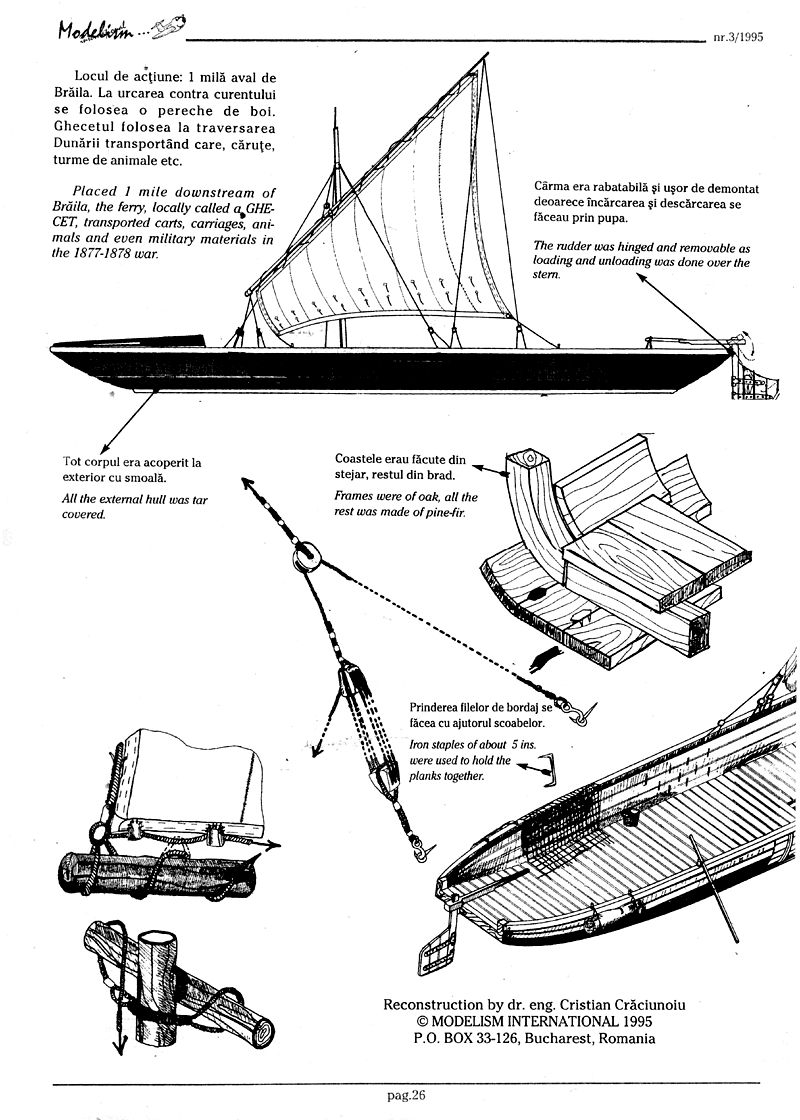
Locul de acțiune: 1 milă aval de Brăila. La urcarea contra curentului se folosea o pereche de boi. Ghecetul folosea la traversarea Dunării transportând care, căruțe, turme de animale etc.
Placed 1 mile downstream of Brăila, the ferry, locally called a GHECET, transported carts, carriages, animals and even military materials in the 1877-1878 war.
Cârma era rabatabilă și ușor de demontat deoarece încărcarea și descărcarea se făceau prin pupa.
The rudder was hinged and removable as loading and unloading was done over the stern.
Tot corpul era acoperit la exterior cu smoală.
All the external hull was tar covered.
Coastele erau făcute din stejar, restul din brad.
Frames were of oak, all the rest was made of pine-fir.
Prinderea filelor de bordaj se făcea cu ajutorul scoabelor.
Iron staples of about 5 ins. were used to hold the planks together.
Reconstruction by dr. eng. Cristian Crăciunoiu
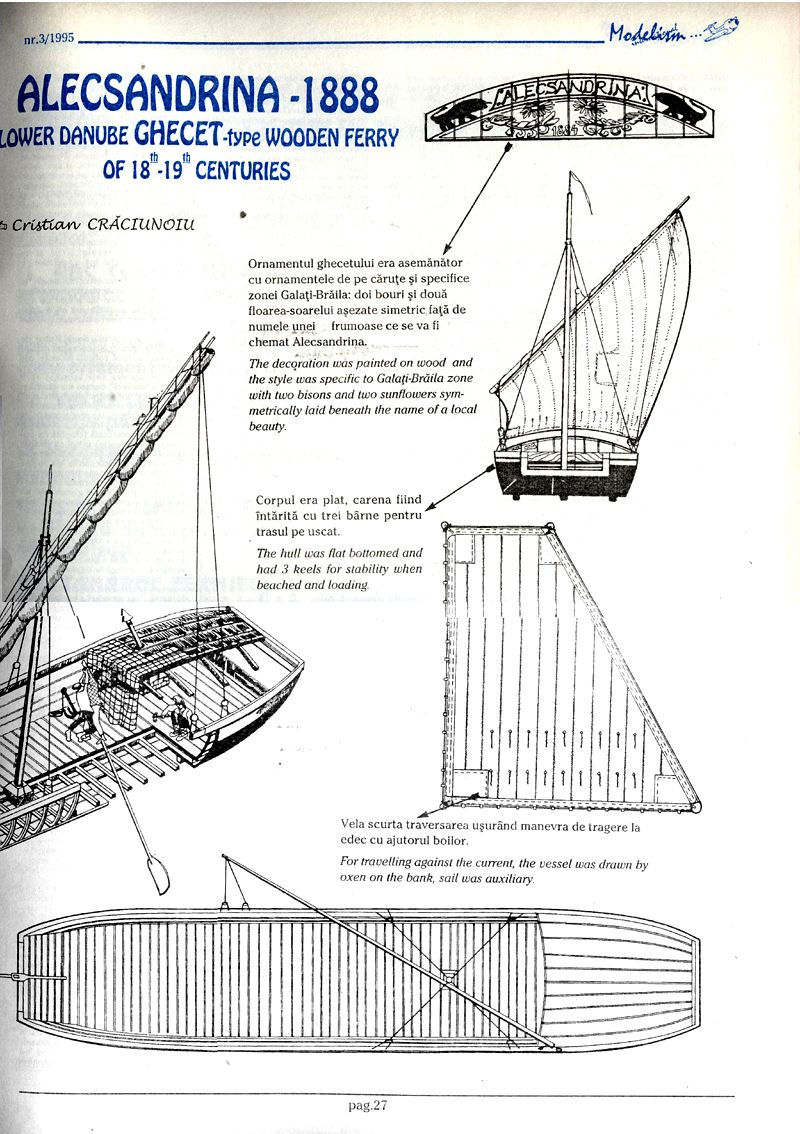
ALECSANDRINA -1888 LOWER DANUBE GHECET-type WOODEN FERRY OF 18-19 CENTURIES Cristian CRACIUNOIU
ALECSANDRINA Ornamentul ghecetului era asemănător cu ornamentele de pe căruțe și specifice zonei Galați-Brăila: doi bouri și două floarea-soarelui așezate simetric față de numele unei frumoase ce se va fi chemat Alecsandrina.
The decoration was painted on wood and the style was specific to Galați-Brăila zone with two bisons and two sunflowers symmetrically laid beneath the name of a local beauty.
Corpul era plat, carena fiind întărită cu trei bârne pentru trasul pe uscat.
The hull was flat bottomed and had 3 keels for stability when beached and loading.
Vela scurta traversarea ușurând manevra de tragere la edec cu ajutorul boilor.
For travelling against the current, the vessel was drawn by oxen on the bank, sail was auxiliary.
GHECET*. Romanian Danube Wooden Ferry of the XVIIIth XIXth Centuries
As the romanian territory is crossed by several rivers, all Danube afluents, it is obvious that crossing these waters was a immemorial long technical problem. Even if written sources mention wooden or stone bridges 3 milenia ago, it is obvious that ferries or "floating bridges as they are populary called here are even older. As almost all tradition in the field disappeared by the nationalization of goods in 1948, we collected photos or drawings for this particullary specific class of traditional wooden boats of Romania, and tried to have a classification of them.
If we consider the way of crossing the river as a criteria, we might have: - Self propelled ferries, by wind or oars - River flow driven ferries, also in two different types: 1. Rope anchored and rudder manoeuvered 2. Rudder manoeuverd and animal traction. - Special designed boats for floating bridges.
For this paper we selected to present a specific wooden ferry for crossing the Danube near Brăila, today forgotten but known last century under the name of GHECET.
Three pictures taken in 1908 and a fourth from the collection of the Romanian Academy, taken in 1893 give us the data for reconstructing the ghecet.
In the very place were they were working, a mile downstream Brăila town, today's Diesel propelled ferries are still working, crossing cars, trucks and people to the village...Ghecet! This is one of the cases when the name of the ferry was given by extension to the place they were and later to the village growing there. But, if you will ask the Inhabitants were does the name of their village come from they will raise the shoulders and send you to ask someone else. This person will do the same and so on... The mayor will tell you that this village is mentioned in the history of turkish-russian wars of the XVIII century and so, it has almost three centuries.
The place was known as ... "la ghecet" meaning the place where you find the ghecet and by extension the village growing there, became Ghecet, even if the wooden ferry that landed its name disappeared.
The pictures show us clearly two kind of executions, as a matter of fact two qualities, for the same traditional boat. These of 1908 are less finished, the planks and even the resistance spars are carved at a minimum level just to fulfill their functional tasks at a low price. The old one, half sunk in the Danube is much more attentive carved so that the planks are more elaborated. The explanation is simple: the turn of the century brought a fast development of the local traffic towards Constantza harbour by land from all Moldavia, and so the ghecets had to became more rentable, being build faster and at a lower price.
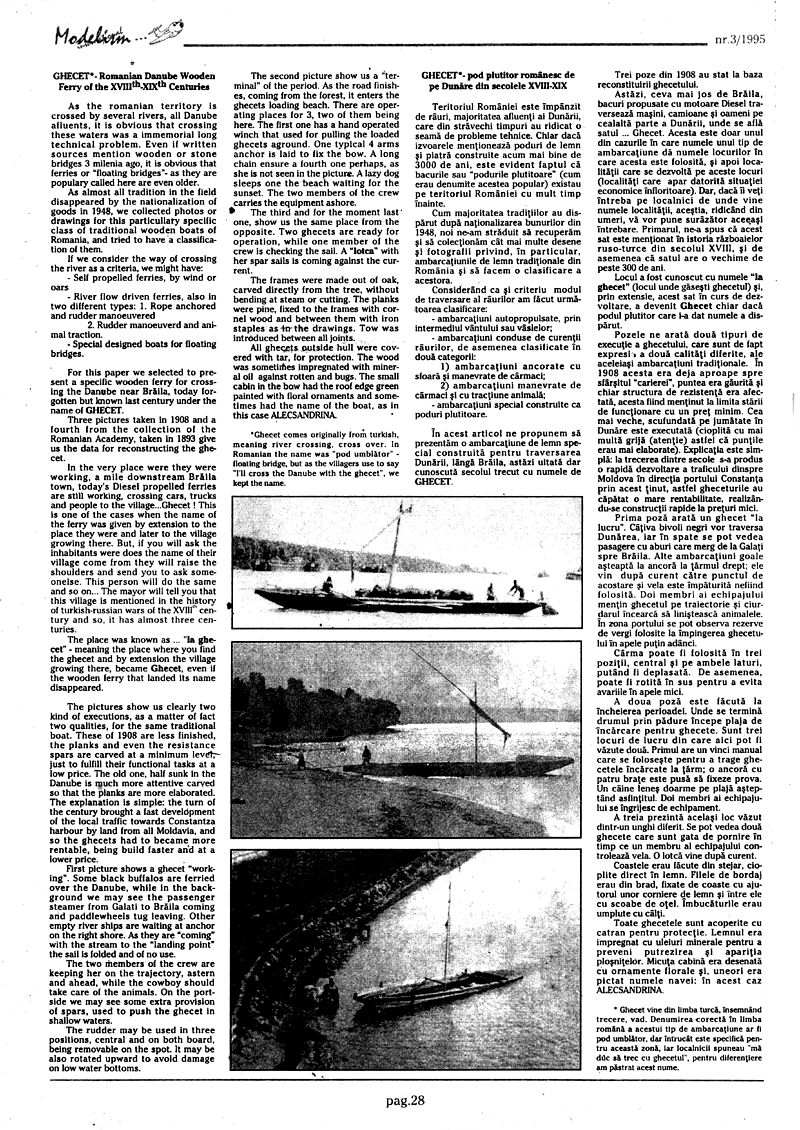
First picture shows a ghecet "working". Some black buffalos are ferried over the Danube, while in the background we may see the passenger steamer from Galati to Brăila coming and paddlewheels tug leaving. Other empty river ships are waiting at anchor on the right shore. As they are "coming" with the stream to the "landing point" the sail is folded and of no use.
The two members of the crew are keeping her on the trajectory, astern and ahead, while the cowboy should take care of the animals. On the portside we may see some extra provision of spars, used to push the ghecet in shallow waters.
The rudder may be used in three positions, central and on both board, being removable on the spot. It may be also rotated upward to avoid damage on low water bottoms.
The second picture show us a "terminal" of the period. As the road finishes, coming from the forest, it enters the ghecets loading beach. There are operating places for 3, two of them being here. The first one has a hand operated winch that used for pulling the loaded ghecets aground. One typical 4 arms anchor is laid to fix the bow. A long chain ensure a fourth one perhaps, as she is not seen in the picture. A lazy dog sleeps one the beach waiting for the sunset. The two members of the crew carries the equipment ashore.
The third and for the moment last one, show us the same place from the opposite. Two ghecets are ready for operation, while one member of the crew is checking the sail. A "lotca" with her spar sails is coming against the current.
The frames were made out of oak, carved directly from the tree, without bending at steam or cutting. The planks were pine, fixed to the frames with cornel wood and between them with iron staples as to the drawings. Tow was introduced between all joints.
All ghecets outside hull were covered with tar, for protection. The wood was sometimes impregnated with mineral oil against rotten and bugs. The small cabin in the bow had the roof edge green painted with floral ornaments and sometimes had the name of the boat, as in this case ALECSANDRINA
*Ghecet comes originally from turkish, meaning river crossing, cross over. In Romanian the name was "pod umblător" - floating bridge, but as the villagers use to say "I'll cross the Danube with the ghecet", we kept the name.
GHECET*- pod plutitor românesc de pe Dunăre din secolele XVIII-XIX
Teritoriul României este împânzit de râuri, majoritatea afluenți ai Dunării, care din străvechi timpuri au ridicat o seamă de probleme tehnice. Chiar dacă izvoarele menționează poduri de lemn și piatră construite acum mai bine de 3000 de ani, este evident faptul că bacurile sau "podurile plutitoare" (cum erau denumite acestea popular) existau pe teritoriul României cu mult timp înainte.
Cum majoritatea tradițiilor au dispărut după naționalizarea bunurilor din 1948, noi ne-am străduit să recuperăm și să colecționăm cât mai multe desene și fotografii privind, în particular, ambarcațiunile de lemn tradiționale din România și să facem o clasificare a acestora.
Considerând ca și criteriu modul de traversare al râurilor am făcut următoarea clasificare: - ambarcațiuni autopropulsate, prin intermediul vântului sau vâslelor, - ambarcațiuni conduse de curentul râurilor, de asemenea clasificate în două categorii: 1) ambarcațiuni ancorate cu sfoară și manevrate de cârmaci; 2) ambarcațiuni manevrate de cârmaci și cu tracțiune animală; - ambarcațiuni special construite ca poduri plutitoare.
În acest articol ne propunem să prezentăm o ambarcațiune de lemn special construită pentru traversarea Dunării, lângă Brăila, astăzi uitată dar cunoscută secolul trecut cu numele de GHECET.
Trei poze din 1908 au stat la baza reconstituirii ghecetului.
Astăzi, ceva mai jos de Brăila, bacuri propulsate cu motoare Diesel traversează mașini, camioane și oameni pe cealaltă parte a Dunării, unde se află satul Ghecet. Acesta este doar unul din cazurile în care numele unui tip de ambarcațiune dă numele locurilor în care acesta este folosită, și apoi localității care se dezvoltă pe aceste locuri (localități care apar datorită situației economice înfloritoare). Dar, dacă îi veți întreba pe localnici de unde vine numele localității, aceștia, ridicând din umeri, vă vor pune surâzător aceeași întrebare. Primarul, ne-a spus că acest sat este menționat în istoria războaielor ruso-turce din secolul XVIII, și de asemenea că satul are o vechime de peste 300 de ani.
Locul a fost cunoscut cu numele "la ghecet" (locul unde găsești ghecetul) și, prin extensie, acest sat în curs de dezvoltare, a devenit Ghecet chiar dacă podul plutitor care i-a dat numele a dispărut.
Pozele ne arată două tipuri de execuție a ghecetului, care sunt de fapt expresia a două calități diferite, ale aceleiași ambarcațiuni tradiționale. În 1908 acesta era deja aproape spre sfârșitul "carierei", puntea era găurită și chiar structura de rezistență era afectată, acesta fiind menținut la limita stării de funcționare cu un preț minim. Cea mai veche, scufundată pe jumătate în Dunăre este executată (cioplită) cu mai multă grijă (atenție) astfel că punțile erau mai elaborate). Explicația este simplă: la trecerea dintre secole s-a produs o rapidă dezvoltare a traficului dinspre Moldova în direcția portului Constanța prin acest ținut, astfel gheceturile au căpătat o mare rentabilitate, realizându-se construcții rapide la prețuri mici.
Prima poză arată un ghecet "la lucru". Câțiva bivoli negri vor traversa Dunărea, iar în spate se pot vedea passagere cu aburi care merg de la Galați spre Brăila. Alte ambarcațiuni goale așteaptă la ancoră la țărmul drept; ele vin după curent către punctul de acostare și vela este împăturită nefiind folosită. Doi membri ai echipajului mențin ghecetul pe traiectorie și ciurdarul încearcă să liniștească animalele. În zona portului se pot observa rezerve de vergi folosite la împingerea ghecetului în apele puțin adânci.
Cârma poate fi folosită în trei poziții, central și pe ambele laturi, putând fi deplasată. De asemenea, poate fi rotită în sus pentru a evita avariile în apele mici.
A doua poză este făcută la încheierea perioadei. Unde se termină drumul prin pădure începe plaja de încărcare pentru ghecete. Sunt trei locuri de lucru din care aici pot fi văzute două. Primul are un vinci manual care se folosește pentru a trage ghecetele încărcate la țărm; o ancoră cu patru brațe este pusă să fixeze prova. Un câine leneș doarme pe plajă așteptând asfințitul. Doi membri ai echipajului se îngrijesc de echipament.
A treia prezintă același loc văzut dintr-un unghi diferit. Se pot vedea două ghecete care sunt gata de pornire în timp ce un membru al echipajului controlează vela. O lotcă vine după curent.
Coastele erau făcute din stejar, cioplite direct în lemn. Filele de bordaj erau din brad, fixate de coaste cu ajutorul unor corniere de lemn și între ele cu scoabe de oțel. Îmbucăturile erau umplute cu câlți.
Toate ghecetele sunt acoperite cu catran pentru protecție. Lemnul era impregnat cu uleiuri minerale pentru a preveni putrezirea și apariția plușnițelor. Micuța cabină era desenată cu ornamente florale și, uneori era pictat numele navei: în acest caz ALECSANDRINA.
*Ghecet vine din limba turcă, însemnând trecere, vad. Denumirea corectă în limba română a acestui tip de ambarcațiune ar fi pod umblător, dar întrucât este specifică pentru această zonă, iar localnicii spuneau "mă duc să trec cu ghecetul", pentru diferențiere am păstrat acest nume.