
Gheorghe Botezatu - George de Bothezat
Scurtă Biografie Gheorghe Botezatu - GEORGE DE BOTHEZAT Dr. ing. Cristian CRĂCIUNOIU
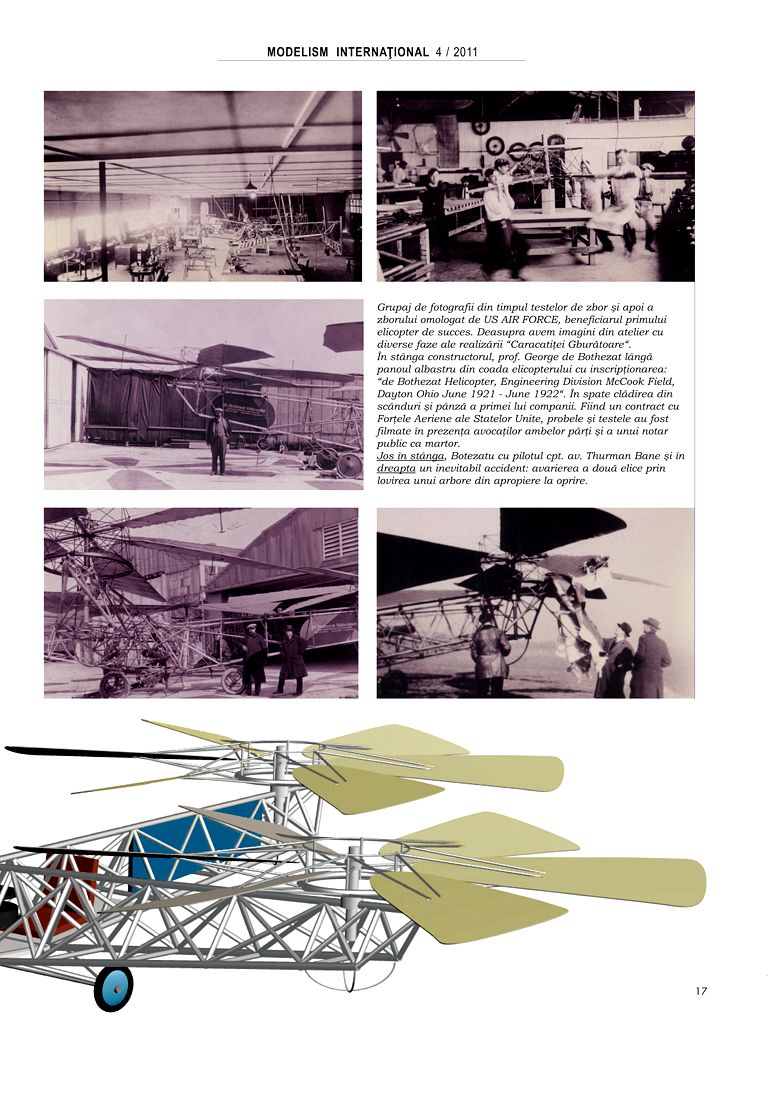
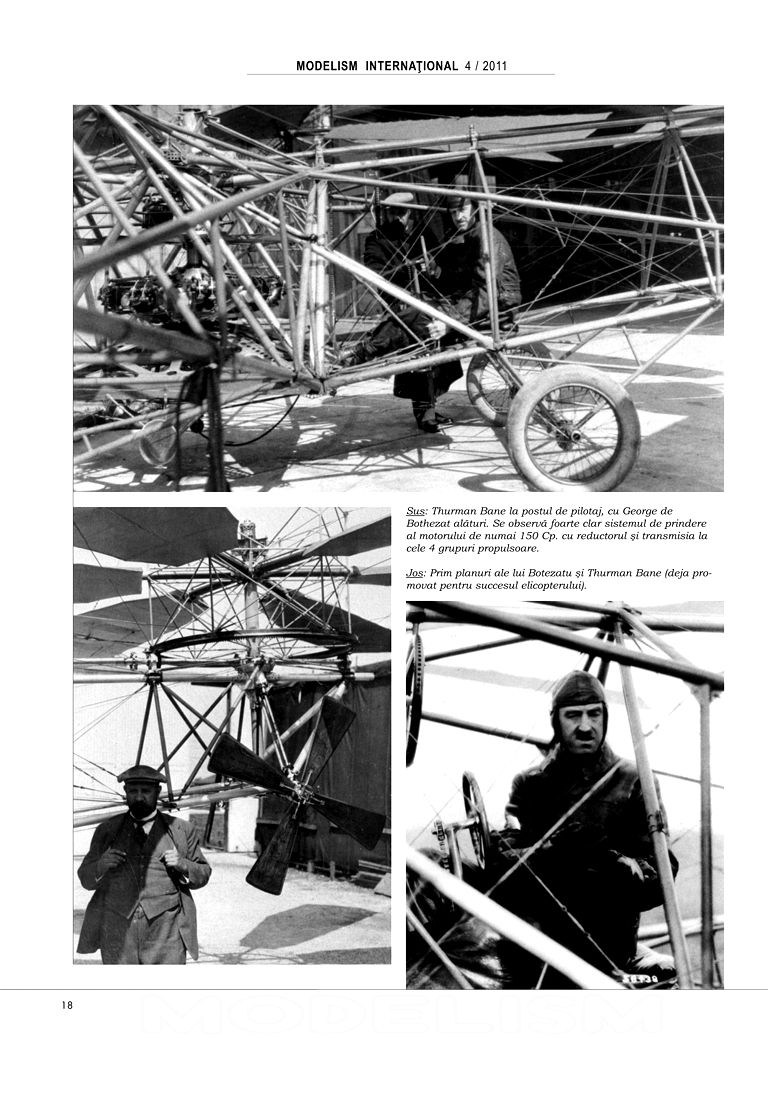
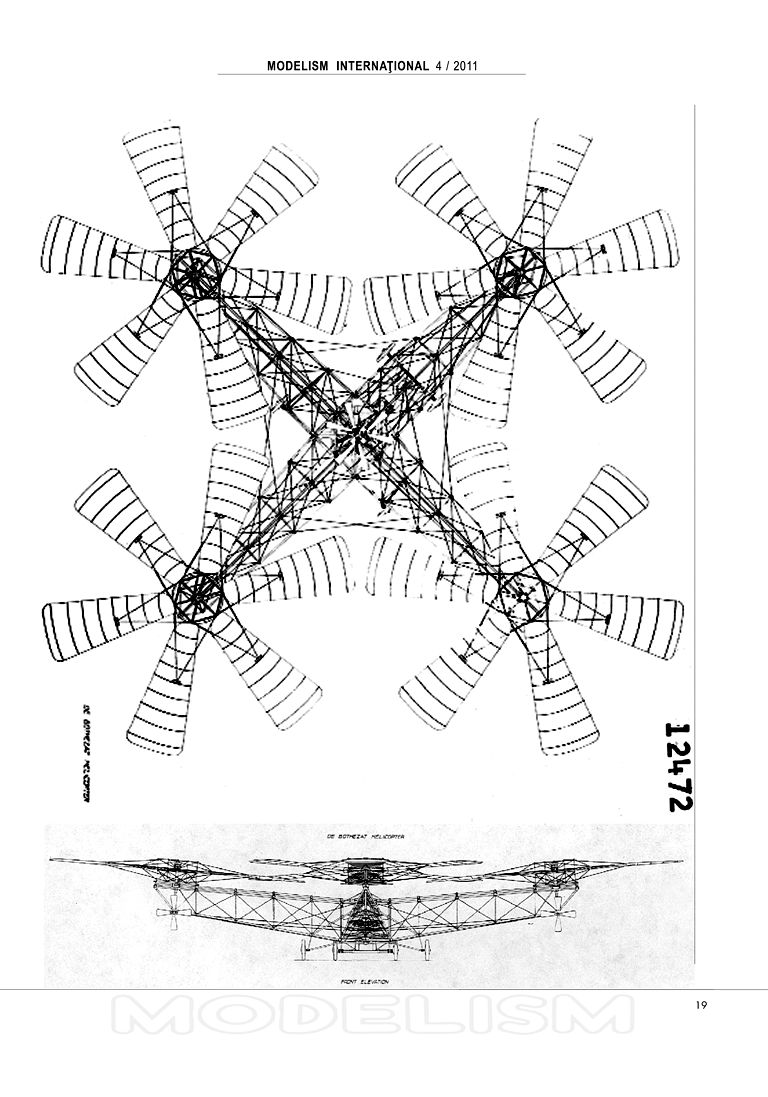
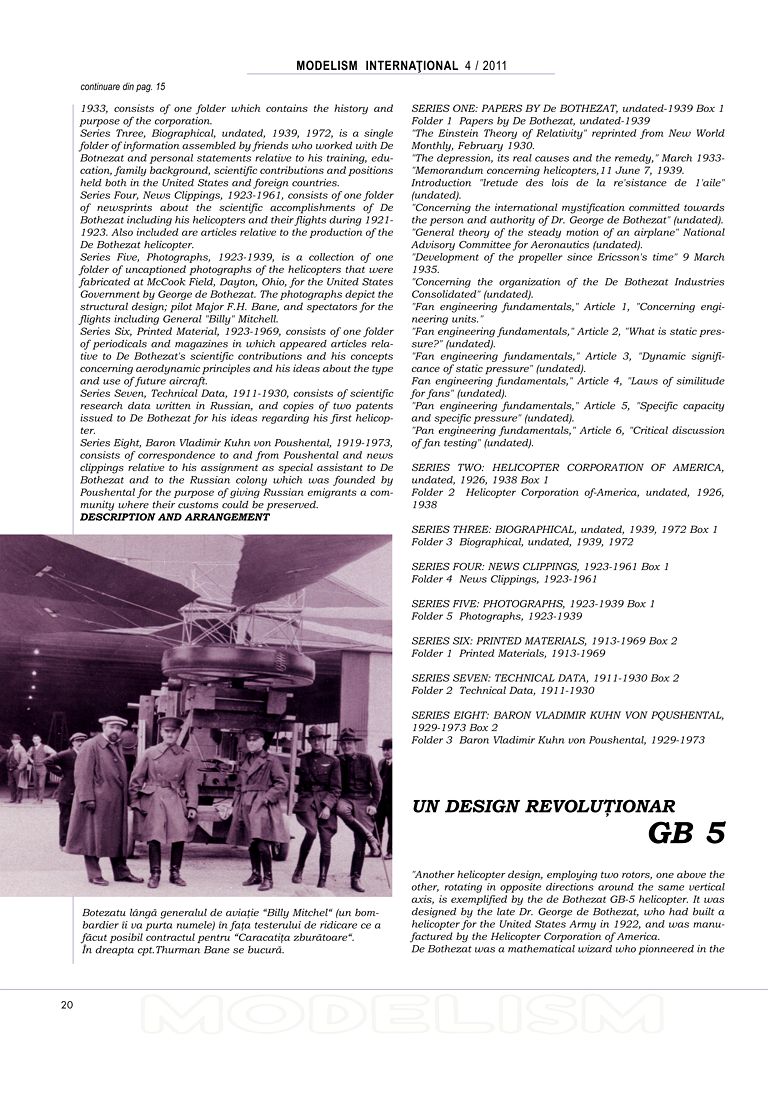
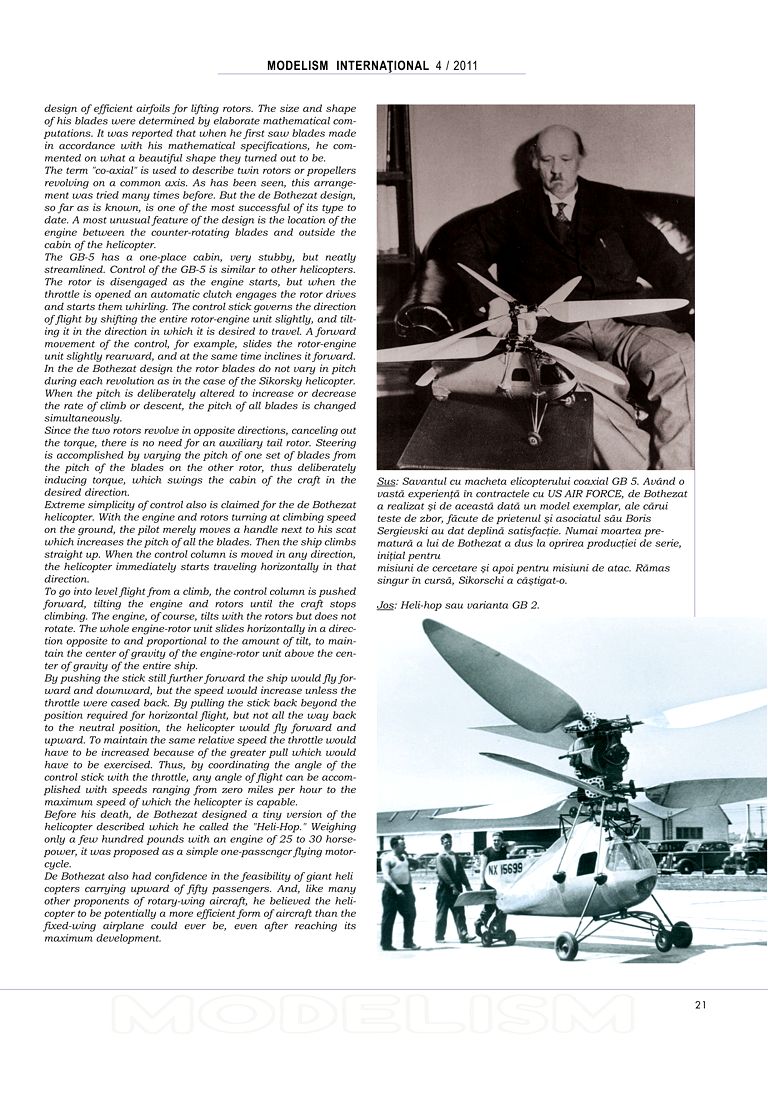
Primul doctor în aerodinamică pe plan mondial cu lucrarea "Etude de la stabilite de l'aeroplane" la Sorbona în 1908; Matematician de geniu, autor al lucrării fundamentale "Teoria Generală a Palelor de Elice", publicată de Guvernul American, ultima ediție la NASA cu indicativul R93-20347- Allison Engine Co - USA; Autor al unor teorii matematice de ieșire din Criza Economică, decorat de președintele Roosevelt; Invitat de Albert Einstein la Princeton pentru discuții publice contradictorii asupra isocronismului în spiritul teoriei relativității cu "duel la tablă" în formule abstracte și vorbe de duh; Inventatorul elicopterului, înaintea lui Sikorschi, cu primul zbor la 18 decembrie 1922 la Dayton, Ohio, în urma primului contract de elicopter al US ARMY. A rămas în aer 1 minut și 42 secunde, cu cpt. Thurman Bane la comenzi; Inventatorul elicopterului cu elici anticuplu, coaxiale, cu GB 5 în 1941 și teste de luptă antitanc.
Originar dintr-o familie de răzeși din partea nordică a Moldovei, s-a născut la 1884. Pe atunci, o parte din familie s-a mutat la Iași iar alta a rămas pe loc, într-o zonă ce trecuse la Imperiul Țarist, devenind cetățeni ruși. Nepoții de al doilea din Iasi, Eugen și Constanța Botezatu au fost intervievați în 1970 de către dr. în istoria aeronauticii Matei Oroveanu.
Studiile preliminare le face acasă, apoi pleacă la școli private din Rusia și Europa de Vest, între anii 1902 - 1911. Obține înalte titluri științifice și distincții de la Institutul Tehnologic din Harkov, Institutul Electrotehnic din Montefiore, Liege, Universitatea din Gotingen, Universitatea din Berlin, Universitattea Sorbona din Paris. Aici susține primul doctorat dedicat aerodinamicii, cu titlul corect "Etude de la stabilite de l'aeroplane".
În anii 1918 1919, același Oroveanu reușește să stabilească prezența lui în România, la Iași, prin fotografii cu rudele. Pleacă apoi în Statele Unite, unde i se recunosc meritele și solicită direct sprijinul baronului Vladimir Kuhn von Poushental, însărcinat ulterior de CIA cu supravegherea refugiaților din Uniunea Sovietică, ca asistent personal. S-a păstrat o cantitate considerabilă de documente ale acestuia despre Bothezat, donate bibliotecii Academiei USAF. Este prezentat ca rus, la fel cum Vuia era prezentat cetățean austro-ungar. Să trecem peste acest detaliu.
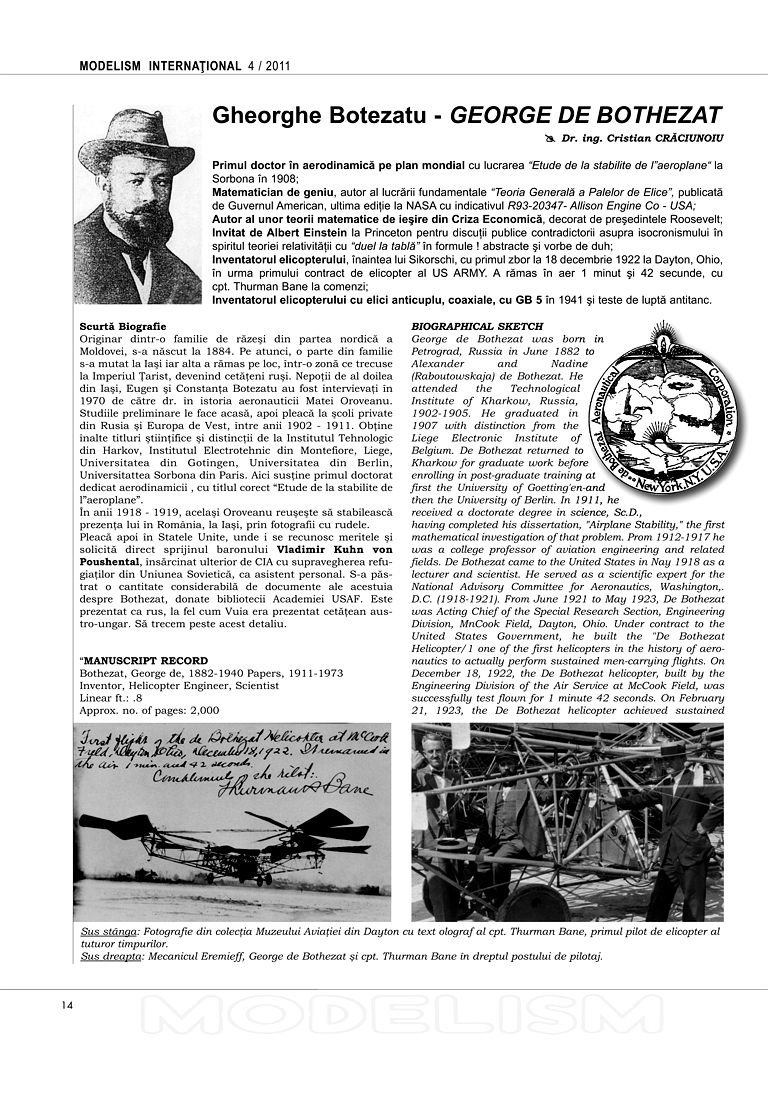
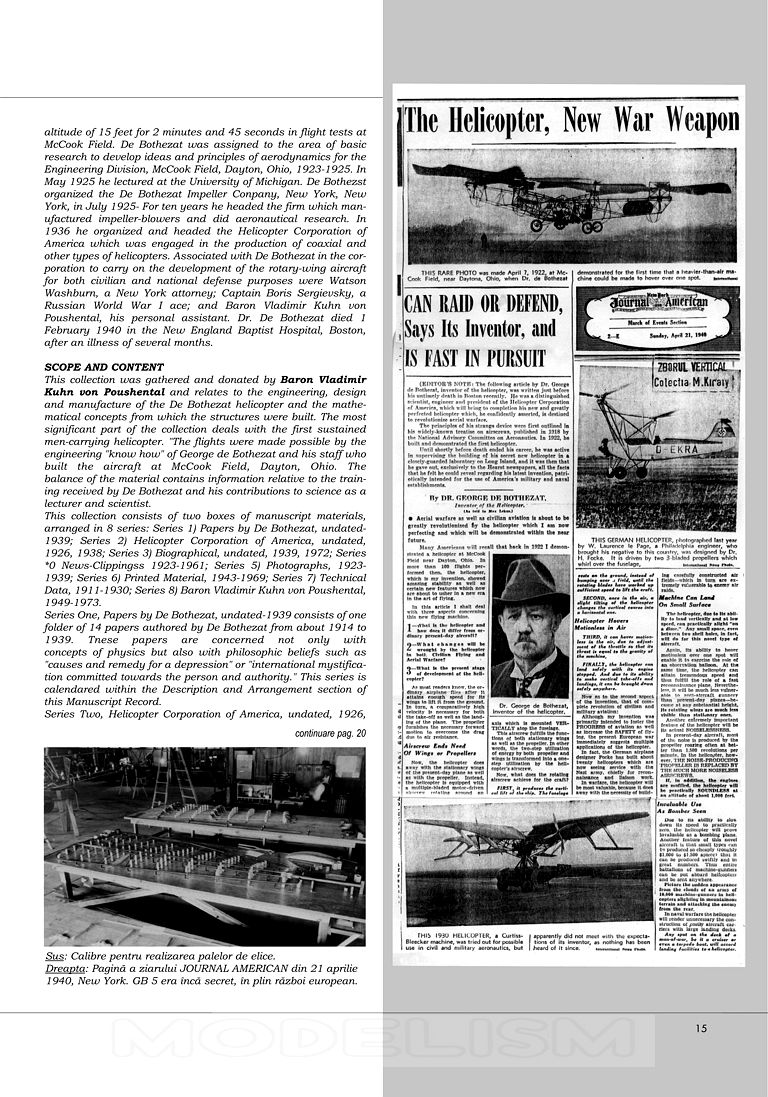
"MANUSCRIPT RECORD Bothezat, George de, 1882-1940 Papers, 1911-1973 Inventor, Helicopter Engineer, Scientist Linear ft.: .8 Approx. no. of pages: 2,000 First flight of the de Bothezat Helicopter at McCook Field, Dayton Ohio, December 18, 1922. The helicopter remained in the air I min. and 42 seconds."
BIOGRAPHICAL SKETCH George de Bothezat was born in Petrograd, Russia in June 1882 to Alexander and Nadine (Raboutowskaja) de Bothezat. He attended the Technological Institute of Kharkow, Russia, 1902-1905. He graduated in 1907 with distinction from the Liege Electronic Institute of Belgium. De Bothezat returned to Kharkow for graduate work before enrolling in post-graduate training at first the University of Goettingen and then the University of Berlin. In 1911, he received a doctorate degree in science, Sc.D., having completed his dissertation, "Airplane Stability," the first mathematical investigation of that problem. From 1912-1917 he was a college professor of aviation engineering and related fields. De Bothezat came to the United States in May 1918 as a lecturer and scientist. He served as a scientific expert for the National Advisory Committee for Aeronautics, Washington, D.C. (1918-1921). From June 1921 to May 1923, De Bothezat was Acting Chief of the Special Research Section, Engineering Division, McCook Field, Dayton, Ohio. Under contract to the United States Government, he built the "De Bothezat Helicopter," one of the first helicopters in the history of aeronautics to actually perform sustained men-carrying flights. On December 18, 1922, the De Bothezat helicopter, built by the Engineering Division of the Air Service at McCook Field, was successfully test flown for 1 minute 42 seconds. On February 21, 1923, the De Bothezat helicopter achieved sustained altitude of 15 feet for 2 minutes and 45 seconds in flight tests at McCook Field. De Bothezat was assigned to the area of basic research to develop ideas and principles of aerodynamics for the Engineering Division, McCook Field, Dayton, Ohio, 1923-1925. In May 1925 he lectured at the University of Michigan. De Bothezat organized the De Bothezat Impeller Company, New York, New York, in July 1925. For ten years he headed the firm which manufactured impeller-blowers and did aeronautical research. In 1936 he organized and headed the Helicopter Corporation of America which was engaged in the production of coaxial and other types of helicopters. Associated with De Bothezat in the corporation to carry on the development of the rotary-wing aircraft for both civilian and national defense purposes were Watson Washburn, a New York attorney; Captain Boris Sergievsky, a Russian World War I ace; and Baron Vladimir Kuhn von Poushental, his personal assistant. Dr. De Bothezat died 1 February 1940 in the New England Baptist Hospital, Boston, after an illness of several months.
SCOPE AND CONTENT This collection was gathered and donated by Baron Vladimir Kuhn von Poushental and relates to the engineering, design and manufacture of the De Bothezat helicopter and the mathematical concepts from which the structures were built. The most significant part of the collection deals with the first sustained men-carrying helicopter. The flights were made possible by the engineering "know how" of George de Bothezat and his staff who built the aircraft at McCook Field, Dayton, Ohio. The balance of the material contains information relative to the training received by De Bothezat and his contributions to science as a lecturer and scientist.
This collection consists of two boxes of manuscript materials, arranged in 8 series: Series 1) Papers by De Bothezat, undated-1939; Series 2) Helicopter Corporation of America, undated, 1926, 1938; Series 3) Biographical, undated, 1939, 1972; Series 4) News Clippings, 1923-1961; Series 5) Photographs, 1923-1939; Series 6) Printed Material, 1943-1969; Series 7) Technical Data, 1911-1930; Series 8) Baron Vladimir Kuhn von Poushental, 1949-1973.
Series One, Papers by De Bothezat, undated-1939 consists of one folder of 14 papers authored by De Bothezat from about 1914 to 1939. These papers are concerned not only with concepts of physics but also with philosophic beliefs such as "causes and remedy for a depression" or "international mystification committed towards the person and authority." This series is calendared within the Description and Arrangement section of this Manuscript Record.
Series Two, Helicopter Corporation of America, undated, 1926, 1938, consists of one folder which contains the history and purpose of the corporation.
Series Three, Biographical, undated, 1939, 1972, is a single folder of information assembled by friends who worked with De Bothezat and personal statements relative to his training, education, family background, scientific contributions and positions held both in the United States and foreign countries.
Series Four, News Clippings, 1923-1961, consists of one folder of newsprints about the scientific accomplishments of De Bothezat including his helicopters and their flights during 1921-1923. Also included are articles relative to the production of the De Bothezat helicopter.
Series Five, Photographs, 1923-1939, is a collection of one folder of uncaptioned photographs of the helicopters that were fabricated at McCook Field, Dayton, Ohio, for the United States Government by George de Bothezat. The photographs depict the structural design; pilot Major F.H. Bane, and spectators for the flights including General "Billy" Mitchell.
Series Six, Printed Material, 1923-1969, consists of one folder of periodicals and magazines in which appeared articles relative to De Bothezat's scientific contributions and his concepts concerning aerodynamic principles and his ideas about the type and use of future aircraft.
Series Seven, Technical Data, 1911-1930, consists of scientific research data written in Russian, and copies of two patents issued to De Bothezat for his ideas regarding his first helicopter.
Series Eight, Baron Vladimir Kuhn von Poushental, 1919-1973, consists of correspondence to and from Poushental and news clippings relative to his assignment as special assistant to De Bothezat and to the Russian colony which was founded by Poushental for the purpose of giving Russian emigrants a community where their customs could be preserved.
DESCRIPTION AND ARRANGEMENT SERIES ONE: PAPERS BY De BOTHEZAT, undated-1939 Box 1 Folder 1 Papers by De Bothezat, undated-1939 "The Einstein Theory of Relativity" reprinted from New World Monthly, February 1930. "The depression, its real causes and the remedy," March 1933. "Memorandum concerning helicopters," June 7, 1939. Introduction "l'etude des lois de la resistance de l'aile" (undated). "Concerning the international mystification committed towards the person and authority of Dr. George de Bothezat" (undated). "General theory of the steady motion of an airplane" National Advisory Committee for Aeronautics (undated). "Development of the propeller since Ericsson's time" 9 March 1935. "Concerning the organization of the De Bothezat Industries Consolidated" (undated). "Fan engineering fundamentals," Article 1, "Concerning engineering units." "Fan engineering fundamentals," Article 2, "What is static pressure?" (undated). "Fan engineering fundamentals," Article 3, "Dynamic significance of static pressure" (undated). "Fan engineering fundamentals," Article 4, "Laws of similitude for fans" (undated). "Fan engineering fundamentals," Article 5, "Specific capacity and specific pressure" (undated). "Fan engineering fundamentals," Article 6, "Critical discussion of fan testing" (undated).
SERIES TWO: HELICOPTER CORPORATION OF AMERICA, undated, 1926, 1938 Box 1 Folder 2 Helicopter Corporation of America, undated, 1926, 1938
SERIES THREE: BIOGRAPHICAL, undated, 1939, 1972 Box 1 Folder 3 Biographical, undated, 1939, 1972
SERIES FOUR: NEWS CLIPPINGS, 1923-1961 Box 1 Folder 4 News Clippings, 1923-1961
SERIES FIVE: PHOTOGRAPHS, 1923-1939 Box 1 Folder 5 Photographs, 1923-1939
SERIES SIX: PRINTED MATERIALS, 1913-1969 Box 2 Folder 1 Printed Materials, 1913-1969
SERIES SEVEN: TECHNICAL DATA, 1911-1930 Box 2 Folder 2 Technical Data, 1911-1930
SERIES EIGHT: BARON VLADIMIR KUHN VON POUSHENTAL, 1929-1973 Box 2 Folder 3 Baron Vladimir Kuhn von Poushental, 1929-1973
Botezatu lângă generalul de aviație "Billy Mitchell" (un bombardier îi va purta numele) în fața testerului de ridicare ce a făcut posibil contractul pentru "Caracatița zburătoare". În dreapta cpt. Thurman Bane se bucură.
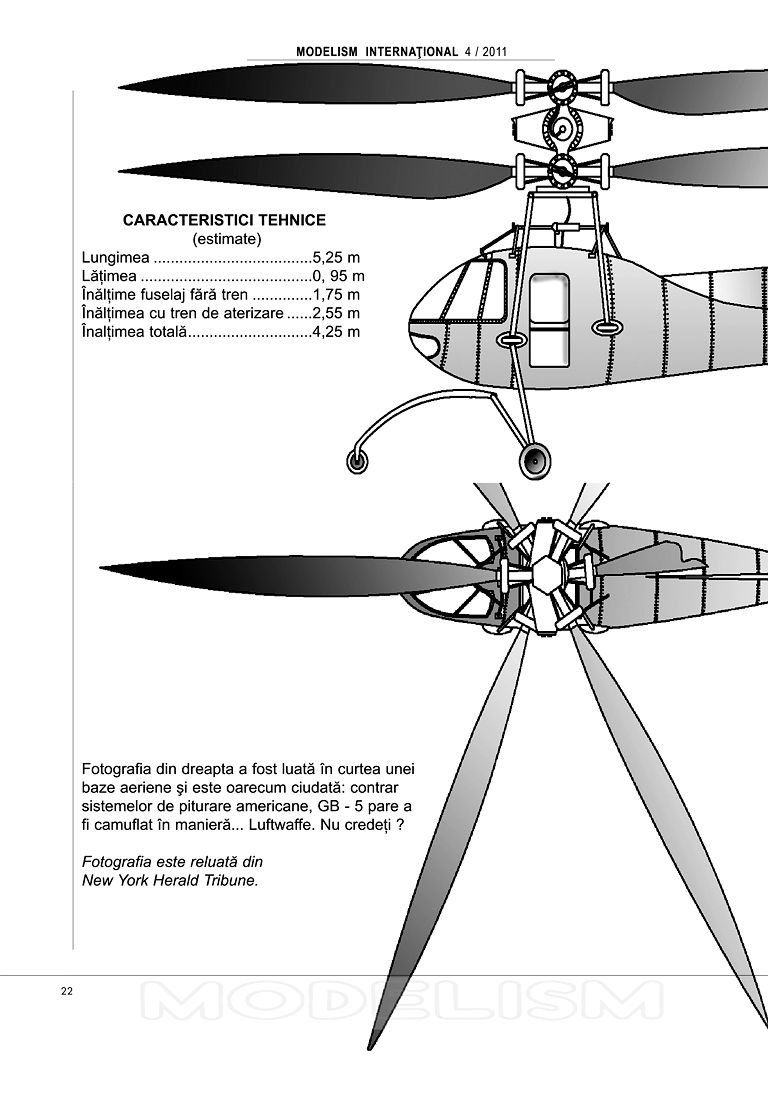
UN DESIGN REVOLUȚIONAR GB 5
"Another helicopter design, employing two rotors, one above the other, rotating in opposite directions around the same vertical axis, is exemplified by the de Bothezat GB-5 helicopter. It was designed by the late Dr. George de Bothezat, who had built a helicopter for the United States Army in 1922, and was manufactured by the Helicopter Corporation of America.
De Bothezat was a mathematical wizard who pioneered in the design of efficient airfoils for lifting rotors. The size and shape of his blades were determined by elaborate mathematical computations. It was reported that when he first saw blades made in accordance with his mathematical specifications, he commented on what a beautiful shape they turned out to be.
The term "co-axial" is used to describe twin rotors or propellers revolving on a common axis. As has been seen, this arrangement was tried many times before. But the de Bothezat design, so far as is known, is one of the most successful of its type to date. A most unusual feature of the design is the location of the engine between the counter-rotating blades and outside the cabin of the helicopter.
The GB-5 has a one-place cabin, very stubby, but neatly streamlined. Control of the GB-5 is similar to other helicopters. The rotor is disengaged as the engine starts, but when the throttle is opened an automatic clutch engages the rotor drives and starts them whirling. The control stick governs the direction of flight by shifting the entire rotor-engine unit slightly, and tilting it in the direction in which it is desired to travel. A forward movement of the control, for example, slides the rotor-engine unit slightly rearward, and at the same time inclines it forward.
In the de Bothezat design the rotor blades do not vary in pitch during each revolution as in the case of the Sikorsky helicopter. When the pitch is deliberately altered to increase or decrease the rate of climb or descent, the pitch of all blades is changed simultaneously.
Since the two rotors revolve in opposite directions, canceling out the torque, there is no need for an auxiliary tail rotor. Steering is accomplished by varying the pitch of one set of blades from the pitch of the blades on the other rotor, thus deliberately inducing torque, which swings the cabin of the craft in the desired direction.
Extreme simplicity of control also is claimed for the de Bothezat helicopter. With the engine and rotors turning at climbing speed on the ground, the pilot merely moves a handle next to his seat which increases the pitch of all the blades. Then the ship climbs straight up. When the control column is moved in any direction, the helicopter immediately starts traveling horizontally in that direction.
To go into level flight from a climb, the control column is pushed forward, tilting the engine and rotors until the craft stops climbing. The engine, of course, tilts with the rotors but does not rotate. The whole engine-rotor unit slides horizontally in a direction opposite to and proportional to the amount of tilt, to maintain the center of gravity of the engine-rotor unit above the center of gravity of the entire ship.
By pushing the stick still further forward the ship would fly forward and downward, but the speed would increase unless the throttle were eased back. By pulling the stick back beyond the position required for horizontal flight, but not all the way back to the neutral position, the helicopter would fly forward and upward. To maintain the same relative speed the throttle would have to be increased because of the greater pull which would have to be exercised. Thus, by coordinating the angle of the control stick with the throttle, any angle of flight can be accomplished with speeds ranging from zero miles per hour to the maximum speed of which the helicopter is capable.
Before his death, de Bothezat designed a tiny version of the helicopter described which he called the "Heli-Hop." Weighing only a few hundred pounds with an engine of 25 to 30 horsepower, it was proposed as a simple one-passenger flying motorcycle.
De Bothezat also had confidence in the feasibility of giant helicopters carrying upward of fifty passengers. And, like many other proponents of rotary-wing aircraft, he believed the helicopter to be potentially a more efficient form of aircraft than the fixed-wing airplane could ever be, even after reaching its maximum development.
Sus: Savantul cu macheta elicopterului coaxial GB 5. Având o vastă experiență în contractele cu US AIR FORCE, de Bothezat a realizat și de această dată un model exemplar, ale cărui teste de zbor, făcute de prietenul și asociatul său Boris Sergievski au dat deplină satisfacție. Numai moartea prematură a lui de Bothezat a dus la oprirea producției de serie, inițial pentru misiuni de cercetare și apoi pentru misiuni de atac. Rămas singur în cursă, Sikorschi a câștigat-o.
CARACTERISTICI TEHNICE (estimate) Lungimea: 5,25 m Lățimea: 0,95 m Înălțime fuselaj fără tren: 1,75 m Înălțimea cu tren de aterizare: 2,55 m Înălțimea totală: 4,25 m
Fotografia din dreapta a fost luată în curtea unei baze aeriene și este oarecum ciudată: contrar sistemelor de pictură americane, GB - 5 pare a fi camuflat în manieră... Luftwaffe. Nu credeți ? Fotografia este reluată din New York Herald Tribune.