
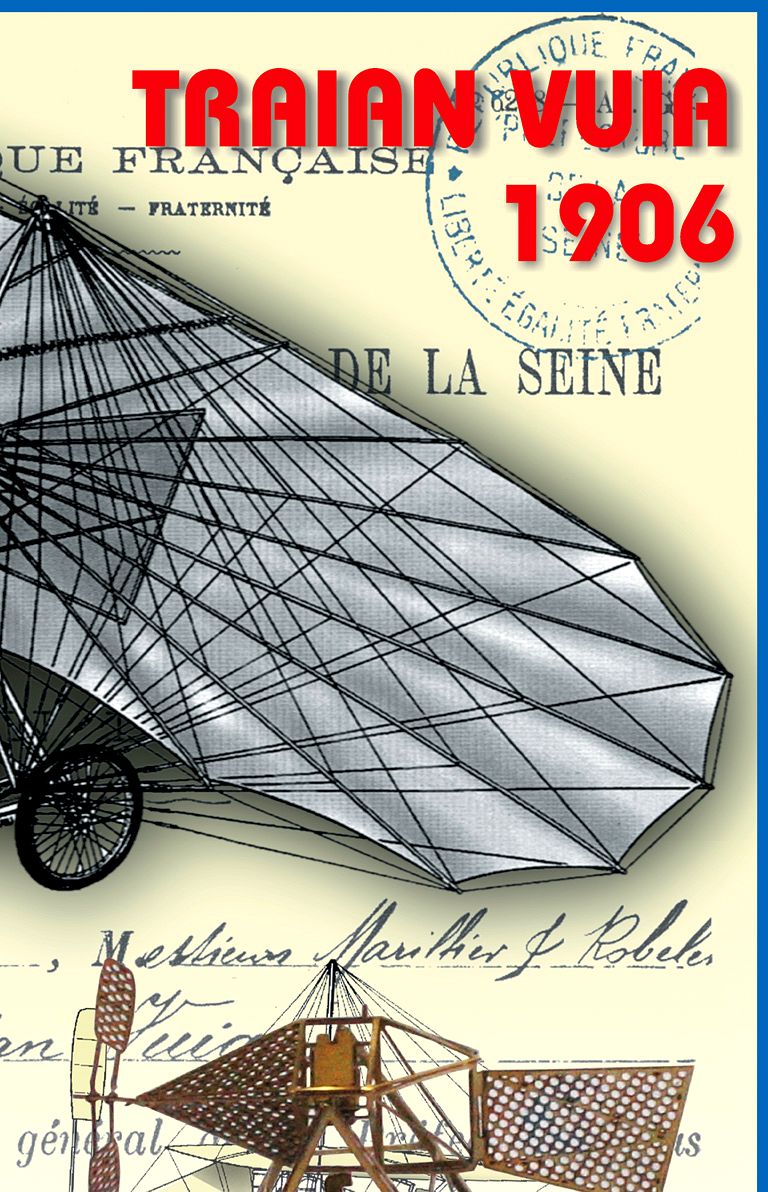
Traian Vuia 1906
Vuia N° 2
TRAIAN VUIA was born on August 7 1872 in the Hurducu Mare village, Timis district, Romania.
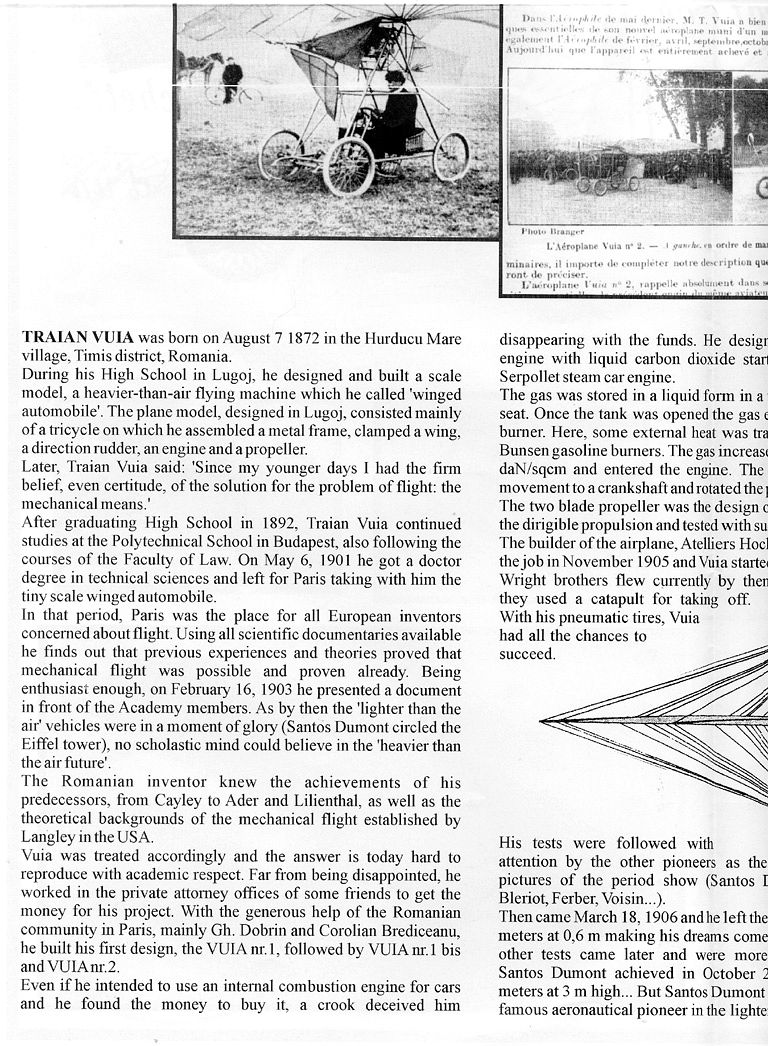
During his High School in Lugoj, he designed and built a scale model, a heavier-than-air flying machine which he called 'winged automobile'. The plane model, designed in Lugoj, consisted mainly of a tricycle on which he assembled a metal frame, clamped a wing, a direction rudder, an engine and a propeller.
Later, Traian Vuia said: 'Since my younger days I had the firm belief, even certitude, of the solution for the problem of flight: the mechanical means.'
After graduating High School in 1892, Traian Vuia continued studies at the Polytechnical School in Budapest, also following the courses of the Faculty of Law. On May 6, 1901 he got a doctor degree in technical sciences and left for Paris taking with him the tiny scale winged automobile.
In that period, Paris was the place for all European inventors concerned about flight. Using all scientific documentaries available he finds out that previous experiences and theories proved that mechanical flight was possible and proven already. Being enthusiast enough, on February 16, 1903 he presented a document in front of the Academy members. As by then the 'lighter than the air' vehicles were in a moment of glory (Santos Dumont circled the Eiffel tower), no scholastic mind could believe in the 'heavier than the air future'.
The Romanian inventor knew the achievements of his predecessors, from Cayley to Ader and Lilienthal, as well as the theoretical backgrounds of the mechanical flight established by Langley in the USA.
Vuia was treated accordingly and the answer is today hard to reproduce with academic respect. Far from being disappointed, he worked in the private attorney offices of some friends to get the money for his project. With the generous help of the Romanian community in Paris, mainly Gh. Dobrin and Corolian Brediceanu, he built his first design, the VUIA nr. 1, followed by VUIA nr. 1 bis and VUIA nr.2.
Even if he intended to use an internal combustion engine for cars and he found the money to buy it, a crook deceived him disappearing with the funds. He designed and built an original engine with liquid carbon dioxide starting from the scrap of a Serpollet steam car engine.
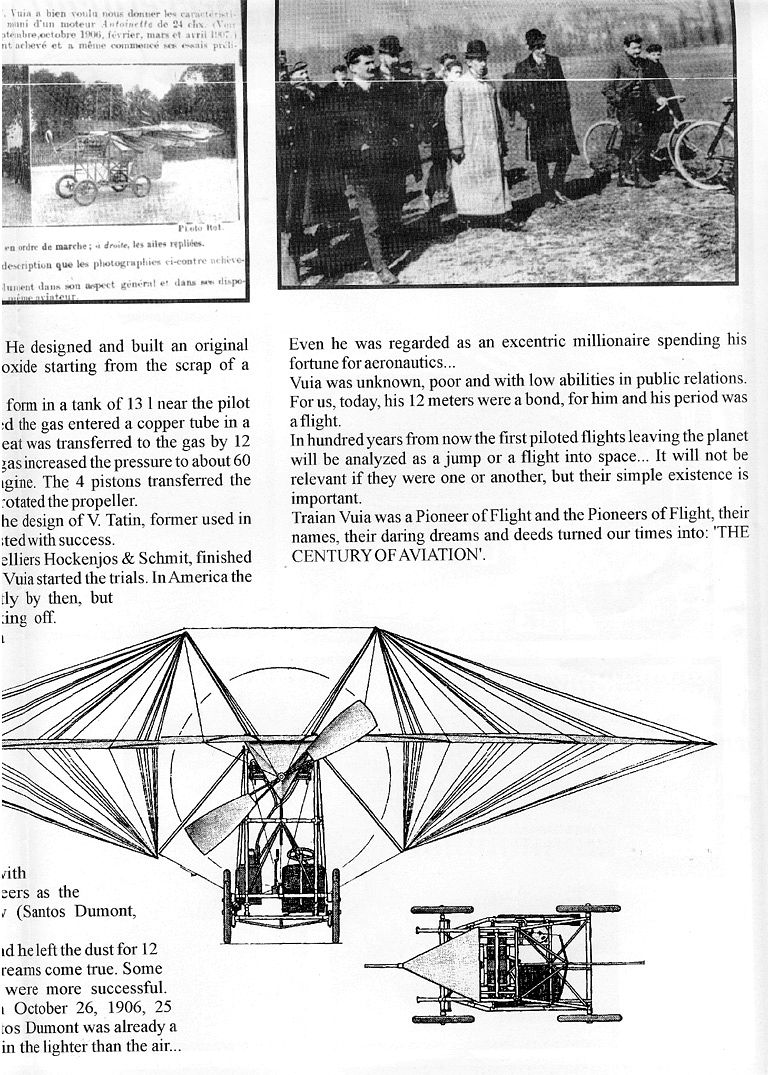
The gas was stored in a liquid form in a tank of 13 l near the pilot seat. Once the tank was opened the gas entered a copper tube in a burner. Here, some external heat was transferred to the gas by 12 Bunsen gasoline burners. The gas increased the pressure to about 60 daN/sqcm and entered the engine. The 4 pistons transferred the movement to a crankshaft and rotated the propeller.
The two blade propeller was the design of V. Tatin, former used in the dirigible propulsion and tested with success.
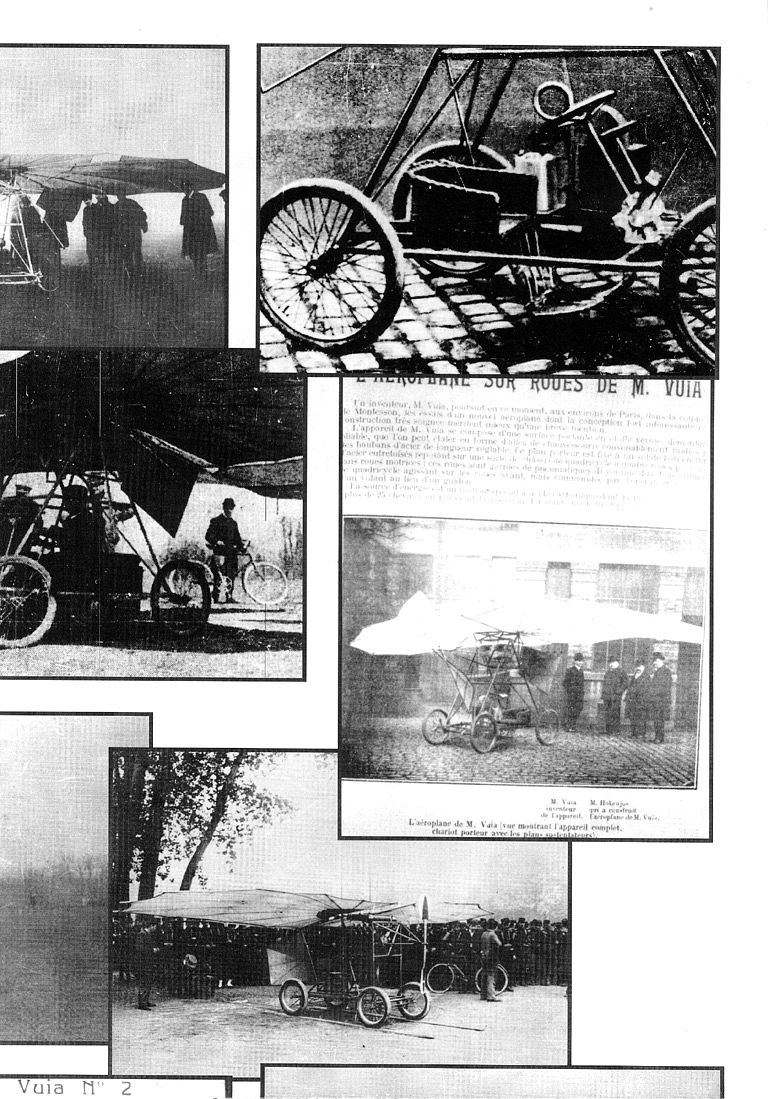
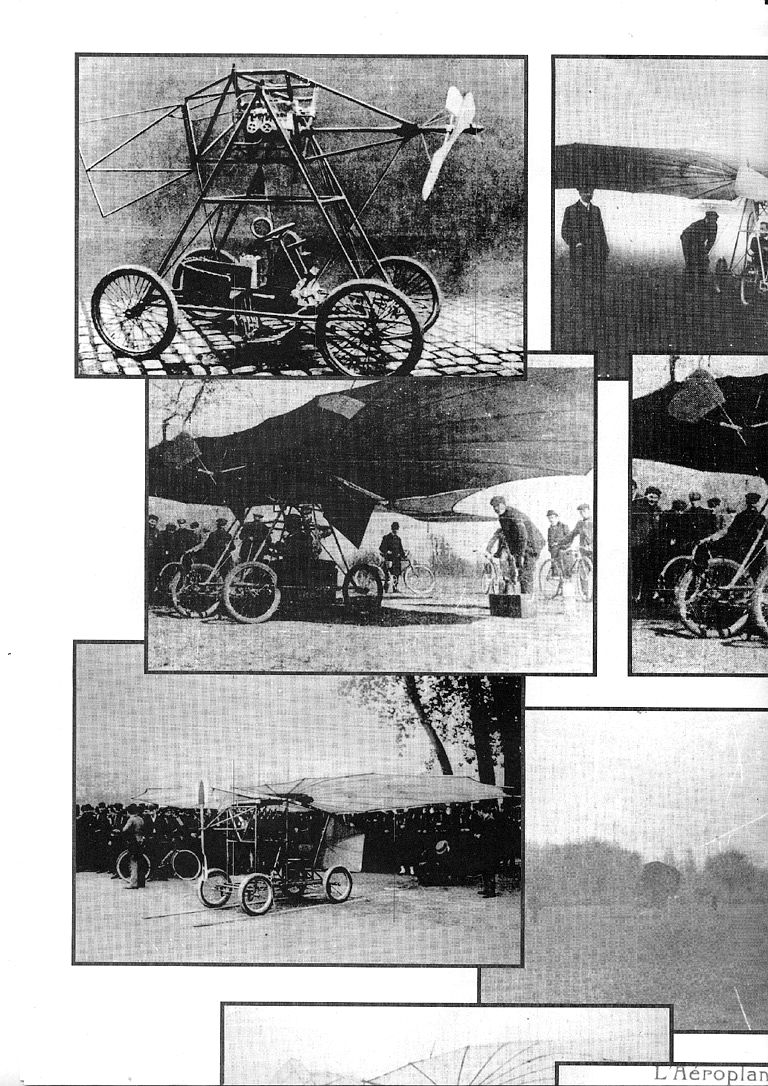
The builder of the airplane, Atelliers Hockenjos & Schmit, finished the job in November 1905 and Vuia started the trials. In America the Wright brothers flew currently by then, but they used a catapult for taking off.
With his pneumatic tires, Vuia had all the chances to succeed.
His tests were followed with attention by the other pioneers as the pictures of the period show (Santos Dumont, Bleriot, Ferber, Voisin...).
Then came March 18, 1906 and he left the dust for 12 meters at 0,6 m making his dreams come true. Some other tests came later and were more successful. Santos Dumont achieved in October 26, 1906, 25 meters at 3 m high... But Santos Dumont was already a famous aeronautical pioneer in the lighter than the air...
Even he was regarded as an excentric millionaire spending his fortune for aeronautics... Vuia was unknown, poor and with low abilities in public relations. For us, today, his 12 meters were a bond, for him and his period was a flight.
In hundred years from now the first piloted flights leaving the planet will be analyzed as a jump or a flight into space... It will not be relevant if they were one or another, but their simple existence is important.
Traian Vuia was a Pioneer of Flight and the Pioneers of Flight, their names, their daring dreams and deeds turned our times into: "THE CENTURY OF AVIATION".
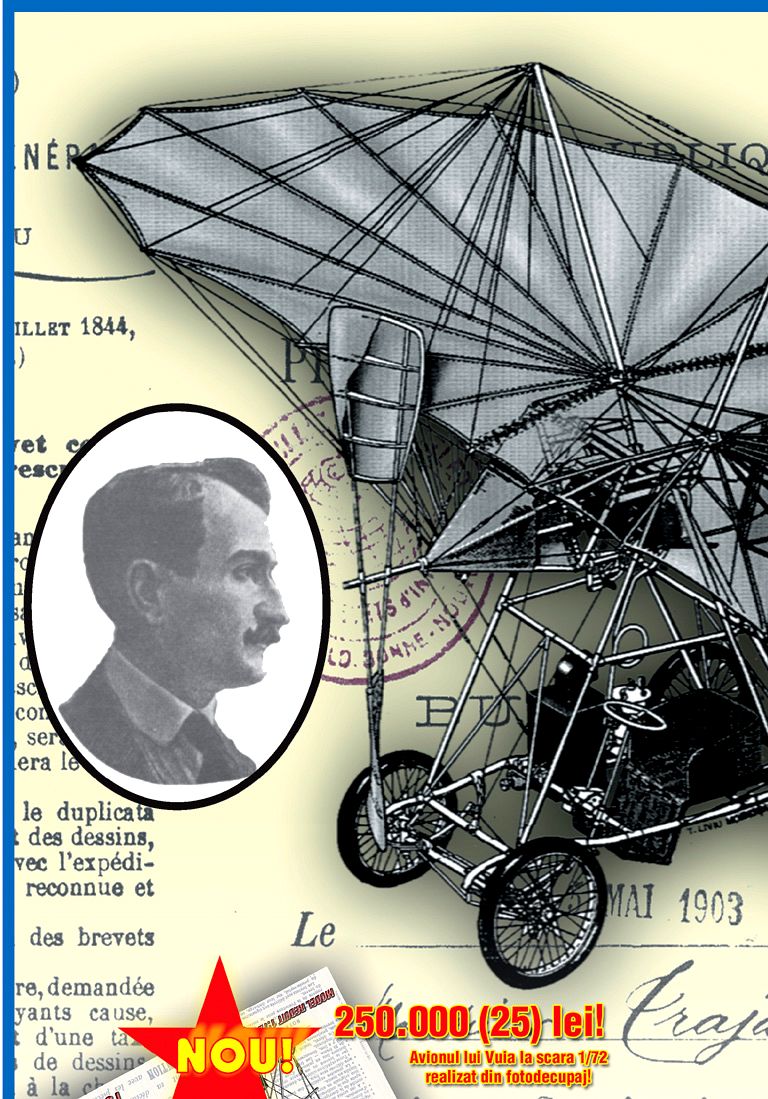
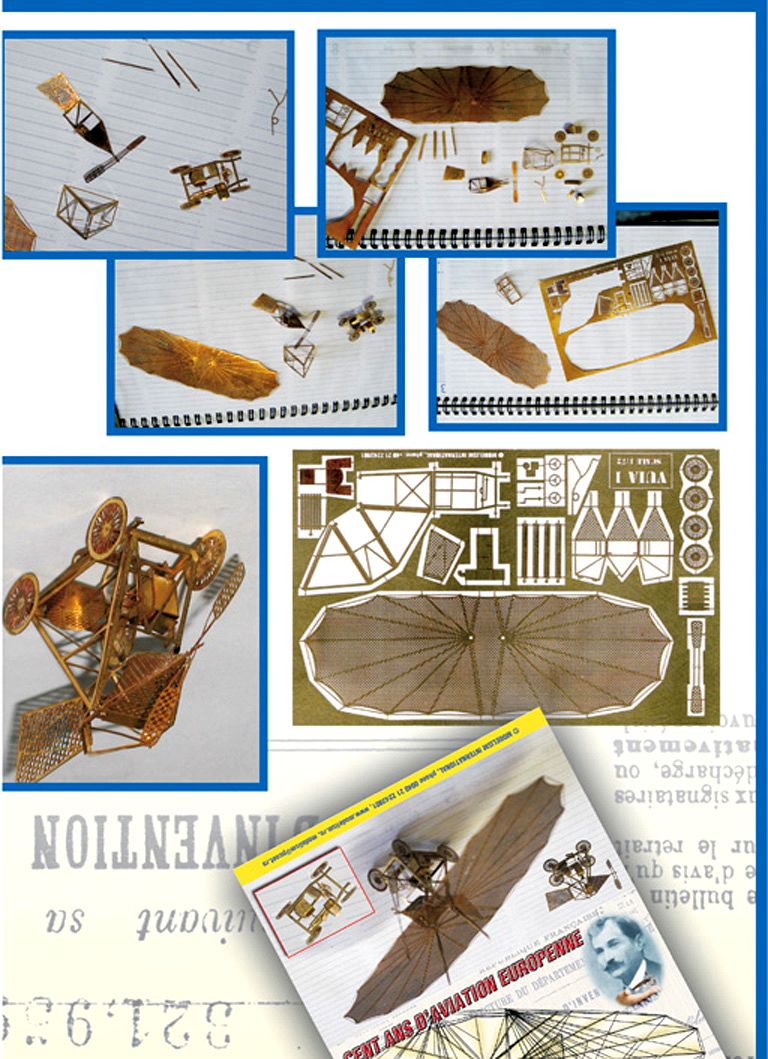
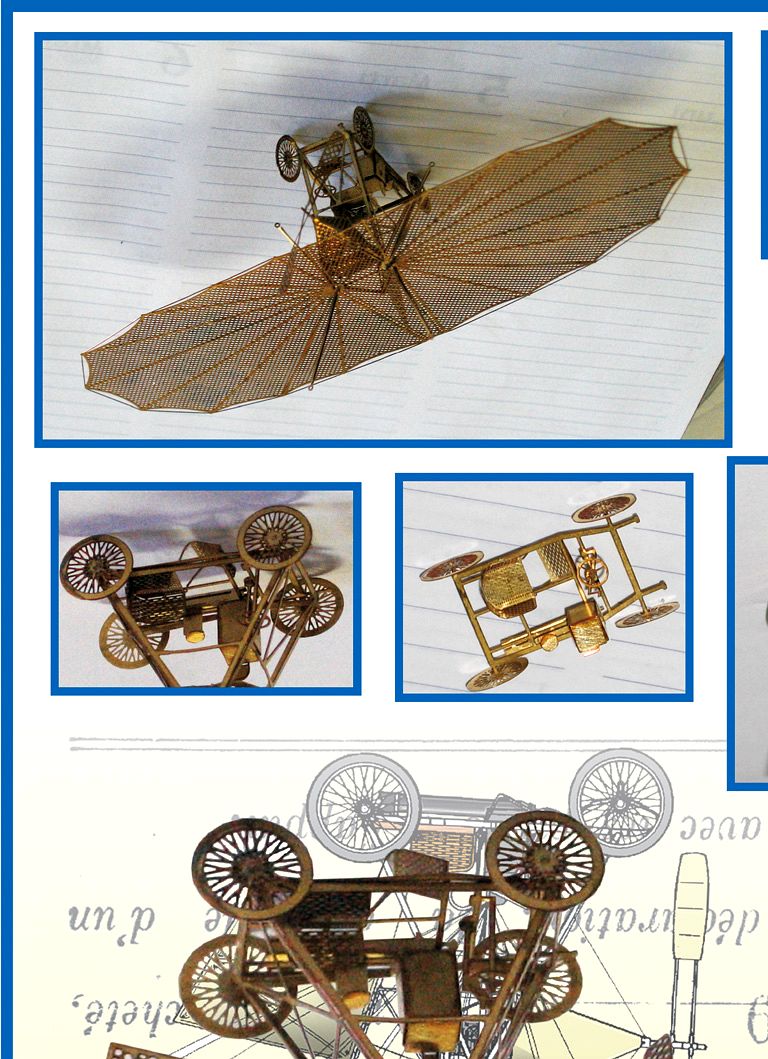
Avionul lui Vuia la scara 1/72 realizat din fotodecupaj!